How to Pay Off Debt Fast: Avalanche vs Snowball (With Real Math)
You are staring at four debt accounts — a credit card at 22.9%, a personal loan at 19.99%, an auto loan at 7.5%, and a student loan at 5.75%. You have $680 per month to throw at them: $480 in minimum payments, and $200 extra. The question is where that $200 goes.
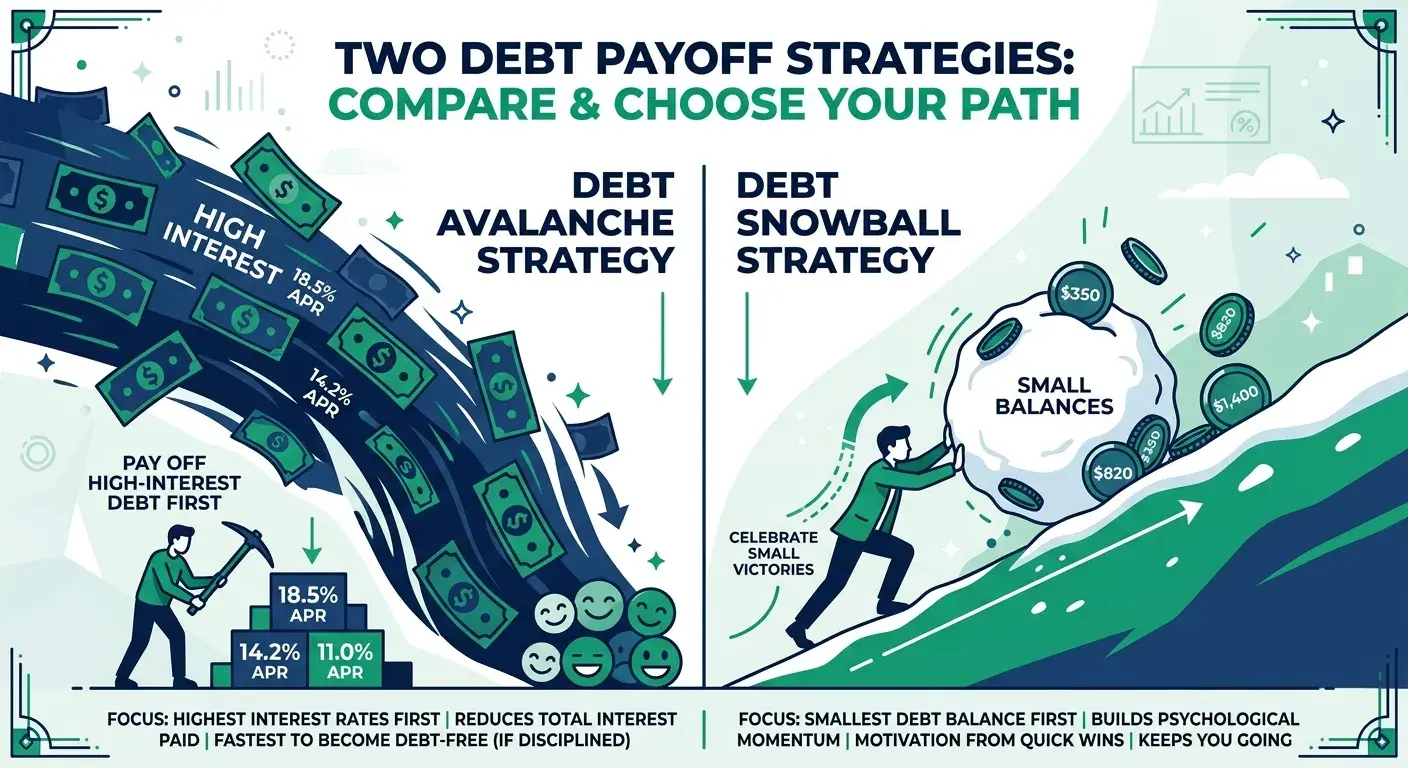
Two strategies dominate personal finance advice: the debt avalanche (attack the highest interest rate first) and the debt snowball (attack the smallest balance first). Every article you find will tell you the avalanche saves more money. Most will then hedge that the snowball is better for motivation. Very few will show you the actual dollar difference.
Let me show you exactly what happens.
The Setup: A Real Debt Load
Here is a representative 4-debt scenario — the kind that lands on financial planners' desks regularly. Total debt: $28,000. Total minimum payment: $480/month. Extra monthly payment available: $200.
| Debt | Balance | APR | Min Payment | Monthly Interest |
|---|---|---|---|---|
| Credit Card | $5,200 | 22.90% | $130 | $99 |
| Personal Loan | $3,800 | 19.99% | $110 | $63 |
| Auto Loan | $12,000 | 7.50% | $160 | $75 |
| Student Loan | $7,000 | 5.75% | $80 | $34 |
| Total | $28,000 | — | $480 | $271 |
Right now, $271 of every $480 minimum payment goes straight to interest. Less than 44 cents of every minimum-payment dollar is reducing principal. This is the hole the strategies are trying to dig out of.
The Debt Avalanche: How It Works
The avalanche method targets the highest interest rate first — regardless of balance size. In this example, that is the credit card at 22.9%.
Month 1: Pay $130 minimum on the credit card, plus the full $200 extra. That's $330 toward a balance that starts at $5,200. Pay minimums on everything else.
Month 14: The credit card is paid off. Its $130 minimum gets rolled into the extra payment. Now you are putting $330/month toward the personal loan at 19.99% — the new top target.
Month 22: Personal loan gone. $440/month rolls to the auto loan at 7.5%.
Month 43: All debt paid off.
Total interest paid, avalanche method: $5,847.
Use the LoanWise debt payoff calculator to model this with your actual balances and rates — the tool runs both strategies simultaneously so you see the gap in seconds.
The Debt Snowball: How It Works
The snowball targets the smallest balance first — regardless of interest rate. In this example, that is the personal loan at $3,800 (not the credit card at $5,200).
Month 1: Pay the $110 minimum on the personal loan, plus the $200 extra. That's $310 toward $3,800.
Month 12: Personal loan paid off. Roll its $110 minimum to the next-smallest: the credit card at $5,200.
Month 28: Credit card done. Roll to student loan.
Month 47: All debt paid off — 4 months later than avalanche.
Total interest paid, snowball method: $7,158.
The Side-by-Side Comparison
| Metric | Avalanche | Snowball | Difference |
|---|---|---|---|
| Payoff timeline | 43 months | 47 months | 4 months |
| Total interest paid | $5,847 | $7,158 | $1,311 |
| First debt paid off | Month 14 (credit card) | Month 12 (personal loan) | 2 months earlier |
| Psychological wins in year 1 | 1 | 1 (earlier) | Snowball wins slightly |
$1,311 is real money. It is a car repair fund, an emergency cushion, or three months of groceries. The avalanche method generates that extra $1,311 by removing the most expensive money first — there is no scenario where it costs you more.
The Part Nobody Talks About: When Snowball Actually Wins
The behavioral research is harder to ignore than the math.
A 2011 paper by Amar, Ariely, Ayal, Cryder, and Rick published in the Journal of Marketing Research tracked 6,000 households using a major bank's debt repayment data. The finding: people who concentrated payments on a single account — the snowball pattern — were more likely to eliminate at least one debt entirely and were more likely to still be making progress 18 months later. Spreading payments across all accounts correlated with higher dropout.
The mechanism is straightforward: crossing a debt off your list triggers a dopamine response. That response reinforces the behavior. Mathematically optimal strategies that do not provide early positive reinforcement get abandoned by real humans under financial stress.
This is not about willpower. It is about systems — specifically, whether the system generates enough feedback to sustain effort for 3–4 years.
So: if you have strong discipline and can stay motivated by abstract progress (a slowly declining total balance), avalanche is better in every measurable way. If you have struggled with debt payoff attempts in the past, or if you know you need tangible wins to stay engaged, the snowball's $1,311 premium may be the cheapest motivation you ever buy.
How to Accelerate Either Strategy
The $200 extra payment in this example is arbitrary. Let me show you exactly what happens when you change it.
| Extra Payment | Avalanche Months | Avalanche Interest | vs. Minimums Only |
|---|---|---|---|
| $0 (minimums only) | 73 months | $11,200 | — |
| $100/month | 54 months | $7,900 | $3,300 saved |
| $200/month | 43 months | $5,847 | $5,353 saved |
| $400/month | 32 months | $4,100 | $7,100 saved |
| $600/month | 26 months | $3,200 | $8,000 saved |
The jump from $0 to $100 extra saves $3,300. The jump from $100 to $200 extra saves another $2,000. Early dollars of extra payment are worth dramatically more than later ones — because you cut off interest accumulation at the highest-rate debt first. Your future self will either thank you or curse you for this decision. The math makes it a lot easier to choose.
Run your own numbers with the debt payoff calculator — the breakdown shows you the exact payoff date and interest total for both strategies with your actual debts. For a broader look at how debt fits into your financial picture, MoneyLens has a debt-to-income analyzer and net worth tracker.
The Action Plan: 6 Steps to Start This Week
- List every debt with balance and APR. Include credit cards, personal loans, auto, student, medical. Get the exact current balance from each lender's website — not your memory.
- Find your minimum payments. Total them up. This is your floor — the amount you owe every month regardless of strategy.
- Determine your extra payment amount. Look at last month's bank statement and find recurring discretionary spending you could redirect. Even $75/month changes the math meaningfully.
- Pick your strategy. If you have strong willpower: avalanche. If you have struggled with debt payoff before, or have a lot of emotional weight around money: snowball. If you are unsure, run the calculator for both and compare the timelines.
- Set up autopay for minimums on everything. Protect your credit score and eliminate the mental overhead of tracking multiple due dates.
- Make the extra payment manually on payday. Automating the extra payment can create problems if cash flow is tight. Doing it manually also makes it feel intentional rather than passive — which reinforces the behavior.
Common Traps That Derail Both Strategies
Not adjusting when a debt is paid off. The entire leverage of both methods comes from the debt roll — taking a freed-up minimum payment and adding it to the next target. Forgetting to roll is the most expensive mistake people make. Set a calendar reminder for when each debt is expected to close.
Taking on new debt during payoff. Every new balance sets back your payoff date. This is especially punishing with revolving credit card debt, because it compounds monthly. If you need to use a credit card during payoff, pay it to zero before the statement closes — every month, without exception.
Underestimating how long this takes. Paying off $28,000 in 43 months is genuinely good progress, but 43 months is nearly 4 years. That is a long time to maintain a behavior change. Build in reviews every 6 months — maybe you get a raise and can increase the extra payment, or maybe you need to temporarily reduce it. The plan should flex with your life.
Frequently Asked Questions
See Your Debt-Free Date
Enter your balances and rates into the LoanWise debt payoff calculator — it runs both strategies simultaneously and shows you the exact interest and timeline difference.
Open Debt Payoff Calculator →